WASHINGTON — WASHINGTON — On July 22, the United States and Saudi Arabia signed a nuclear cooperation agreement more than a year in the making. Twenty-four hours later, the Trump administration imposed a new condition that was not included in the initial agreement.
The deal started life in November of 2025, when Energy Secretary Chris Wright and Prince Abdulaziz signed a “Joint Declaration on the Completion of Negotiations on Civil Nuclear Cooperation” agreement during Crown Prince Mohammed bin Salman’s White House visit — the actual legal groundwork for the eventual agreement. The visit included a major defense sale package and other agreements according to the Energy Department.
Wright, in a statement after signing, had said: “Today is a historic day for the United States and the Kingdom of Saudi Arabia… we want to grow our partnership, bring American nuclear technology to Saudi Arabia and keep a firm commitment to nonproliferation.” Before that signing in November, Wright had personally discussed building Saudi Arabia’s commercial nuclear industry with Prince Abdulaziz during a visit to the kingdom.
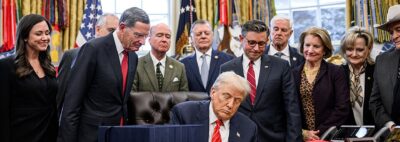
On July 22, 2026, Wright and Prince Abdulaziz formally signed a civil nuclear cooperation agreement establishing a US-supported civilian nuclear program in Saudi Arabia. The deal requires approval from Congress, which has 90 days to consider it, which means the agreement wasn’t completely final even before Trump’s prior conditioning.
One day after that signing — less than 24 hours later — Trump posted on Truth Social that the deal, that was already signed, “will be approved, but is totally subject to Saudi Arabia joining the very respected and successful Abraham Accords,” a brand new condition that was never in the original agreement. That same day, White House Press Secretary Karoline Leavitt confirmed the President’s stance, telling reporters: “the deal is off” if Saudi Arabia doesn’t join the Abraham Accords. Leavitt also said she did not believe Trump had spoken with Mohammed bin Salman since posting his new condition, though he had raised the issue with him previously.
In the same Truth Social post adding the Abraham Accords condition, Trump also denied the deal would permit Saudi Arabian uranium enrichment at all, saying: “There will be no enrichment of material!” and that “The United States is not opposed to Civil (Non-Enriched) Nuclear Facilities.” Trump’s statement directly contradicts reporting on the agreement’s actual terms.
The deal states that Saudi Arabia is not permitted to reprocess U.S. nuclear material for weapons purposes. However, neither the deal nor its accompanying bilateral security protocol forbids the kingdom from using American tech to enrich uranium domestically for civilian purposes, according to NPR.
Multiple outlets, citing U.S. officials, describe a real, if conditional, pathway to domestic enrichment. Before uranium enrichment could begin, a joint US-Saudi team would first explore whether it’s warranted and commercially viable, then Americans would build any enrichment facility without transferring the underlying sensitive technology directly to Saudi Arabia, according to a report by CNN.
Israeli Prime Minister Benjamin Netanyahu’s office issued a public statement, welcoming the condition, directly tying it to the Iran war: “The joint American and Israeli military action against the genocidal regime in Tehran and Israel’s crushing of Iran’s terror axis have created the possibility to expand the circle of peace… Saudi Arabia’s joining of the Abraham Accords would be an historic leap forward for peace in the Middle East.” NPR reported they had reached out to the Saudi Embassy in Washington for a comment, but never received a response.
This marked a surprising reversal of a deliberate policy choice. Reuters reported that, prior to the deal’s signing, the U.S. had specifically stopped demanding Saudi Arabia normalize relations with Israel as a precondition for nuclear cooperation talks — a move Reuters characterized as “a major concession” by Washington. This broke from the Biden administration’s approach, which had explicitly tied nuclear talks to normalization and a broader defense treaty.
Saudi Arabia has consistently said it would not recognize Israel without a Palestinian state — a well-documented and longstanding position that even frustrated the Biden administration’s efforts to expand the Abraham Accords.
The deal was reportedly deliberately designed to remove that obstacle to separate nuclear cooperation from normalization efforts — then after signing the administration independently added the obstacle back, without agreement from the Saudis.
CNN, citing a source familiar with the matter, reported that Trump was already angry that Energy Secretary Wright had not told him he would be announcing the deal the way he did — while waves of criticism from nonproliferation experts and conservative media outlets came in after the terms of the agreement became public, further pushing his frustrations.