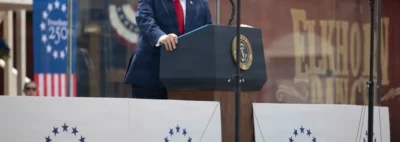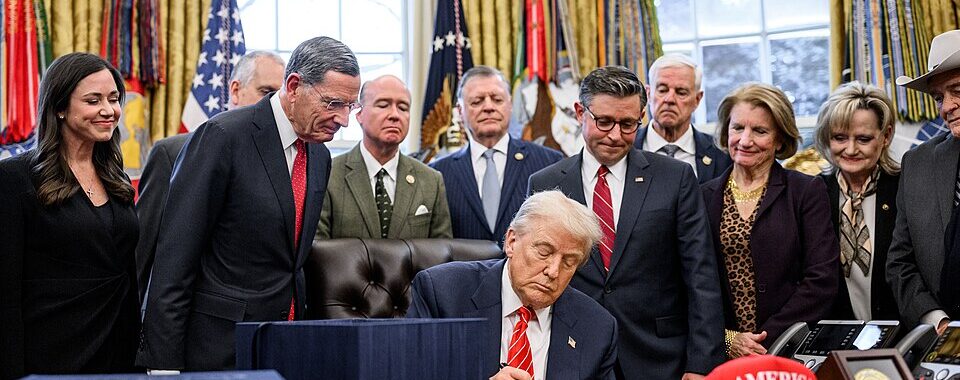
President Donald Trump, said he wasn’t going to sign a bipartisan housing affordability bill on Friday, calling it a “big yawn.”
Speaking in the Oval Office last Monday, President Trump said he was still deciding whether to sign H.R. 6644, the House’s 21st Century ROAD to Housing Act, and the Senate’s ROAD to Housing Act, merged together making the complete bill.
“I will not sign the Housing Bill… in PROTEST over the fact that the United States Senate is not capable of passing THE SAVE AMERICA ACT.” Trump wrote in a post on Truth Social.
The 21st Century ROAD to Housing Act, a bipartisan bill passed by the Senate 89-10 and the House 358-32, has been called the biggest housing affordability overhaul in decades. Among its provisions, the bill bans corporate landlords who own 350 or more single-family homes from purchasing additional ones, and removes a federal requirement that manufactured homes retain a permanent wheeled chassis, a change expected to cut construction costs by roughly $5,000 to $10,000 per home. The bill also streamlines environmental review and local permitting to boost housing supply, and includes no new federal spending.
The bill received bipartisan support from lawmakers in both parties. Rep. French Hill (R-Ark.) sponsored the legislation, alongside Rep. Maxine Waters (D-Calif.), the committee’s ranking member. Two subcommittee leaders, Rep. Mike Flood (R-Neb.) and Rep. Emanuel Cleaver (D-Mo.), also helped lead the bill through Congress.
Congress passed the bill June 23-24; Trump abruptly canceled his own signing ceremony meant to take place on June 24th, saying he wanted the SAVE America Act prioritized first. On June 29th, House Speaker Mike Johnson transmitted the bill to the White House several days after that cancellation, which began a 10-day window that expired last night. President Trump did not sign or veto the bill within that window meaning the bill became law automatically last midnight, even without his signature. Article I of the Constitution requires the bill to become law if the president doesn’t act within 10 days while Congress is in session.
This is certainly not the first time a bill became law without a President’s Signature. Franklin D. Roosevelt let the Internal Revenue Act of 1938 become law, through Article 1 of the Constitution, as did Richard Nixon with several bills, including a special milk program for children in 1970 and the Emergency Community Faclities Act later that year. Presidents can use this route for different reasons. Sometimes disagreeing with certain parts of a bill but not wanting the political fight that a veto would bring, or that they consider the bill small enough that a formal signing ceremony is too much effort.
Historically when Presidents have used this route it was over a disagreement on a section of a bill, or it was just that the bill was minor. Trump’s case is different: the housing bill passed with overwhelming bipartisan margins, and his objection isn’t the content of the bill but to a separate, unrelated piece of legislation.
Saber News reached out to the offices of Rep. French Hill, and Maxine Waters, prior to publication for a comment. Neither office had responded as of publication.